


There’s nothing worse than a ticking, crackling, or hissing radiator waking you up just as you’re falling asleep. Bedroom radiator noises don’t just annoy you, they turn a room meant for rest into somewhere you can’t relax. Usually, trapped air, thermal expansion, or water moving through an older system causes the problem, and quick fixes like bleeding the radiator rarely stop the noise for long.
Silent electric radiators offer a proper long-term fix. They have no water, no pressure, and no trapped air, so nothing inside them can make noise. At Best Electric Radiators, we’ve been designing and supplying silent electric heating to UK homes since 2014, so we know exactly what works and what doesn’t.
In this guide, we’ll walk you through the most common bedroom radiator noises, what causes them, why DIY fixes often don’t last, and how silent electric radiators can give you back a quiet night’s sleep for good.
Why Bedroom Radiators Are Noisier Than Other Rooms
Ever noticed your bedroom radiator makes more noise than the ones downstairs? You’re not imagining it. Bedroom radiators often sit at the highest point of your heating system, which is exactly where air pockets collect. That trapped air is what causes most of the gurgling, knocking, and hissing people complain about upstairs.
There’s also the timing. Your bedroom radiator runs during the quietest hours of the day, so every tick and creak sounds louder than it would in a busy kitchen or living room. And because most heating systems drop the temperature overnight and kick back in early morning, bedroom radiators go through bigger heating and cooling cycles, which means more expansion, more contraction, and more of those clicking sounds.
Add in the fact that you’re trying to sleep next to it, and a small noise turns into something that keeps you awake all night.
Common Bedroom Radiator Noises and What They Mean
Every radiator noise has a specific cause, and once you know what you’re listening for, it’s much easier to work out what’s going on. Here are the sounds you’re most likely to hear in a bedroom, and what each one usually means.
Banging or Knocking Noise
A sudden bang or a repeated knocking sound is one of the most alarming radiator noises, but it’s also one of the most common. It usually comes down to one of three things:
- Water hammer – when water moving through the pipes suddenly changes direction or gets blocked, it slams against the pipework with a loud thud
- Loose pipes – pipes that aren’t clipped down properly knock against floorboards or walls as they heat up and expand
- Faulty or wrong-way-round TRVs – thermostatic radiator valves only work in one direction. If one’s fitted the wrong way, water forces the valve shut and creates a knocking sound every time the heating cycles
If the banging only happens when the heating turns on or off, it’s almost always a water hammer or a valve problem. If it’s random, it’s more likely to be loose pipes.
Gurgling or Bubbling Sounds
Gurgling is the noise that wakes most people up, and it’s almost always caused by trapped air inside the radiator. Bedrooms tend to get hit worse because they’re usually upstairs, and air naturally rises to the highest point of your heating system.
You’ll often hear it along with:
- Cold spots at the top of the radiator
- The radiator is taking longer than usual to heat up
- A bubbling sound when the heating first comes on
Bleeding the radiator will clear it out, but if gurgling keeps coming back, air is getting into the system somewhere, usually from low pressure or a small leak that needs looking at.
Hissing or Whistling Noise
A hissing or whistling sound is water moving too fast through a narrow gap. This normally happens when:
- The water pressure in your system is too high
- A valve isn’t fully open, so water’s being forced through a small opening
- There’s a small leak somewhere in the pipework
Whistling radiators often go hand in hand with a boiler that sounds louder than usual. Check your pressure gauge first, it should sit between 1 and 1.5 bar when the heating’s off. If it’s higher, releasing a bit of water usually fixes it.
If the hissing doesn’t stop and you can’t find an obvious cause, don’t ignore it. A slow leak can quietly damage floors and walls for months before you notice.
Clicking or Ticking Sounds
Clicking and ticking are the most common bedroom radiator noises, and in most cases, they’re completely harmless. The sound comes from metal expanding and contracting as the radiator heats up and cools down.
The real question is why you hear it more in some rooms than others. Usually, it’s because the radiator is sitting directly against its metal wall brackets without the small plastic spacers that should separate them. When the metal expands, it scrapes or ticks against the bracket instead of sliding freely.
This was actually the exact fix one homeowner found after months of sleep-disrupting clicks; lifting the radiator a few millimeters off its brackets stopped the noise completely.
If your radiator clicks but only when the heating starts up or shuts off, that’s normal thermal movement. If it clicks constantly while the heating runs, it’s worth checking the brackets.
Crackling Noises
Crackling is usually a sign of limescale or sludge building up inside your heating system. Plumbers often call this “kettling”, and it sounds exactly like a kettle on the boil because it’s caused by the same thing: hard water deposits forming on hot metal surfaces.
You’re more likely to hear crackling if:
- You live in a hard water area (most of southern and eastern England)
- Your heating system is more than 10 years old
- You haven’t had the system flushed in a while
Left alone, the crackling gets worse. Sludge blocks pipes, the boiler works harder, and the noise eventually turns into proper banging. A power flush usually sorts it out, but it’s not a quick job and needs a heating engineer.
Rattling or Vibrating
A rattling or buzzing sound means something’s physically loose. The most common culprits are:
- Pipe clips that have come away from the wall or joist
- A TRV that’s worn out or fitted loosely
- The radiator itself is shifting against its brackets
- Pipes running through wooden joists without padding
The easiest way to find the source is to lightly press on different parts of the radiator and surrounding pipework while the heating’s on. If the noise stops when you press somewhere, that’s your loose part.
Rattling rarely fixes itself. If anything, it gets worse over time as the loose component wears down whatever it’s knocking against.
Here’s a quick look at common issues with traditional bedroom heaters and how a silent electric radiator offers a quieter, more efficient solution:
| Traditional Bedroom Heater Problems | Silent Electric Radiator Advantages |
| The radiator is making a crackling noise | Operates silently without the typical noises |
| Inconsistent heating | Provides even, consistent warmth |
| Radiator hissing noise | No water circulation means no hissing sounds |
| Frequent maintenance issues | Low-maintenance design with fewer moving parts |
By switching to a silent electric radiator, you can enjoy a quieter, more comfortable bedroom free from the common issues of traditional heaters.

Why Traditional Fixes Are Only a Temporary Solution
Bleeding, balancing, flushing, and tightening the pipes, these all help for a bit. The problem is that none of them stops the noise from coming back:
- Bleed your radiator, and more air finds its way back in within months
- Flush the system, and the sludge starts building up again
- Tighten loose pipes, and the metal still expands every time the heating kicks in
The truth is, a wet heating system will always make noise somewhere. Water moving, air collecting, metal expanding and contracting, it’s just how they work. That’s why you end up bleeding the same bedroom radiator again and again, and the clicking or gurgling keeps coming back a few weeks later.
You’re not doing anything wrong. You’re just fighting a problem the system creates on its own.
How to Choose the Right Silent Electric Radiator for Your Bedroom?
Choosing the right silent electric radiator for your bedroom is key to creating a warm, quiet space. Here’s how to make the best choice and ensure both comfort and efficiency.
Assess Your Room Size and Heating Needs
Start by looking at the size of your bedroom. Larger rooms need more powerful bedroom radiators to keep the space warm, while smaller rooms do fine with less wattage.
At Best Electric Radiators, we offer a range of radiator sizes to fit any bedroom, with widths from 100mm to 1299mm and heights from 500mm to 1800mm. If you’re not sure what size fits your room best, our radiator calculator gives you a quick answer based on your room dimensions.
Determine the Right Wattage
Wattage of your silent electric radiator is crucial for delivering the proper heat. Too much wattage can lead to overheating, while too little may leave your room chilly.
Choosing the correct wattage that fits your room’s dimensions helps keep your space warm and your heating efficient, avoiding unnecessary energy use that can lead to radiator noise.
Each wattage serves specific room sizes and heating needs. Here’s how to choose the perfect fit:
| Wattage | Room Size | Best Suited For |
| 600W | Very small (under 6 m²) | En-suites, small utility spaces |
| 750W | Tiny rooms (under 7 m²) | Cloakrooms, small box rooms |
| 800W | Small (6–8 m²) | Cloakrooms, very small spaces |
| 900W | Small (7–9 m²) | Compact kitchens, bathrooms |
| 1000W | Small to medium (8–10 m²) | Kids’ bedrooms, small offices |
| 1200W | Compact (10–12 m²) | Small bedrooms, compact living areas |
| 1500W | Standard (12–15 m²) | Standard double bedrooms, home offices |
| 1800W | Medium (15–18 m²) | Medium living rooms, lounges |
| 2000W | Medium to large (18–20 m²) | Master bedrooms, larger kitchens |
| 3000W | Large (22 m²+) | Open-plan rooms, high-ceilinged spaces |
Smart Controls, Timers, and Energy-Saving Modes
When you’re picking a silent electric radiator for your bedroom, it’s worth paying attention to how you’ll actually control it day to day. A good model should make heating your room easier, not add another thing to fiddle with.
Look for:
- Wi-Fi control – lets you adjust the temperature from your phone, so you can warm up the bedroom before you head upstairs or turn it down from bed
- Voice control – compatibility with Google Assistant or Alexa is handy if you already use smart speakers at home
- A 24/7 programmable timer – this is the most useful feature for bedrooms. You can set the radiator to warm up before bedtime, dip slightly while you’re asleep, and kick back in before you wake up
- Energy-saving or eco mode – keeps the room at a steady temperature using less power, which matters more than ever with current electricity prices
If you’re planning to upgrade more than one room, check whether the radiators can be grouped together. Our range lets you connect up to 30 radiators to a single Wi-Fi network, so you can run the whole house from one app instead of setting each room separately.
For bedrooms especially, timers are what make the biggest difference. You get warmth when you actually need it, nothing is wasted while you’re out or asleep, and no sudden heating cycles in the middle of the night.
Placement for Even, Quiet Heating
Where you place your silent radiator affects both heat distribution and noise. Position the radiator under a window or on an interior wall to spread heat evenly and reduce any potential noise. Avoid blocking it with furniture or curtains, which can trap heat and cause uneven heating.
Design, Style, and Safety Features
Your bedroom radiator is going to be on the wall for years, so it’s worth picking one that actually fits the room, both how it looks and how it behaves.
On the design side, think about:
- Orientation – vertical models save wall space and work well in smaller bedrooms, while horizontal ones sit neatly under windows
- Profile – slimline radiators barely stick out from the wall, which makes them a good option near beds and furniture
- Color – white and anthracite are the most popular, but you’ll also find options in stone, black, grey, brass, and copper if you want something that blends in or stands out
- Style – flat panel models look clean and modern, while column-style or decorative designs suit traditional or period bedrooms.
On the safety side, a few features are worth checking for before you buy:
- Overheat protection – the radiator shuts itself off if it ever gets too hot, which is especially useful overnight
- Child locks – stop small hands from changing the settings if you have kids
- Anti-tip or secure wall mounting – important if the radiator is within reach of a bed or cot
- Splash protection – worth checking if your bedroom has an en-suite close by.
A good silent electric radiator should feel like part of the room, not something you’re trying to hide. Take a bit of time to match the style to your space, and pick a model with the safety features that actually matter for how your bedroom is used.
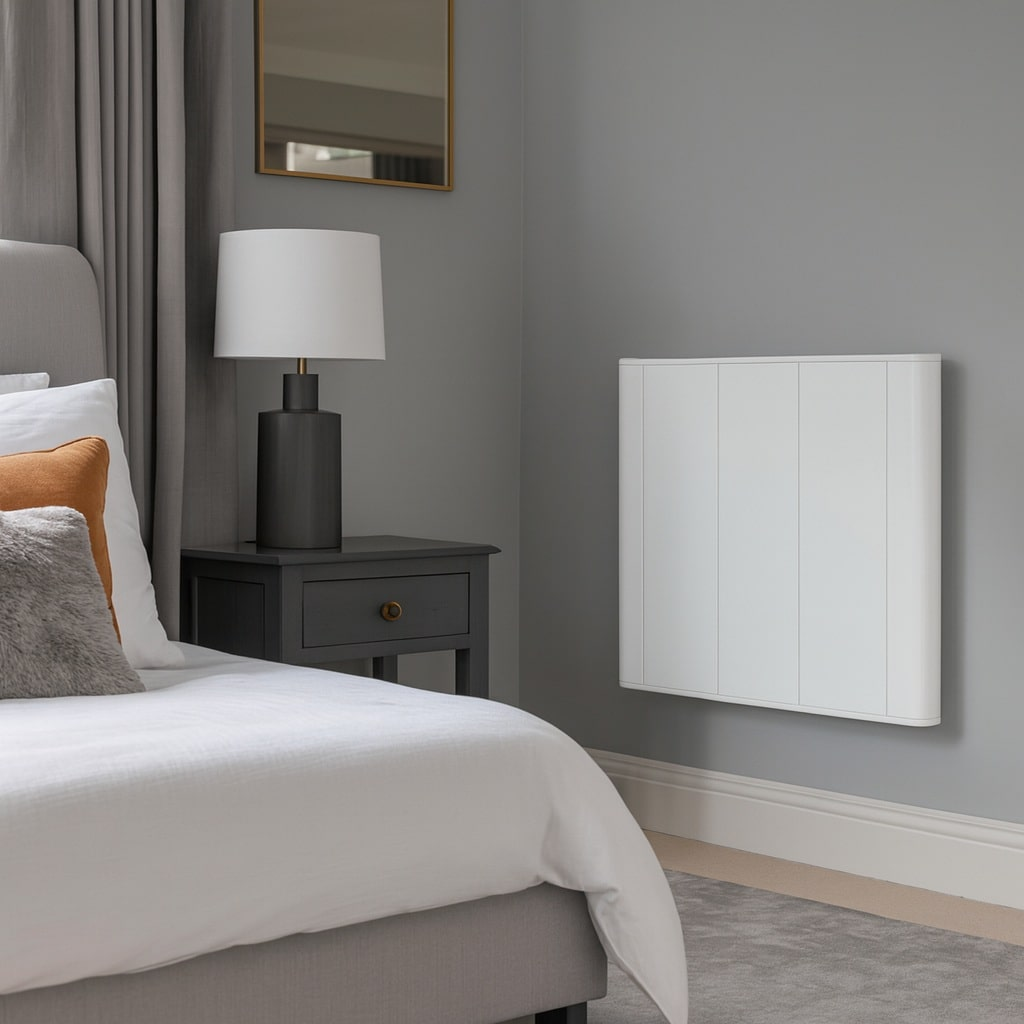
Why Choose Silent Electric Radiators for Bedrooms?
Silent electric radiators are designed to provide warmth without the annoying radiator noises that often come with traditional heating systems.
Unlike conventional radiators, these units operate without water circulation or moving parts, eliminating radiator hissing, radiator making crackling noise, and other disruptive sounds. This makes them perfect for bedrooms, where peace and quiet are essential for restful sleep.
Here are 8 benefits of having silent electric radiators in your bedroom:
1. Completely Silent Operation for Peaceful Sleep
With no water flowing, no pressure changes, and no moving parts, silent electric radiators simply don’t have anything inside them that can make noise. No gurgling, no banging, no hissing, just warmth. That means no more waking up at 3 a.m. to a ticking radiator or reaching for earplugs just to get through the night.
2. No Pressure, No Kettling or Sludge
Kettling and sludge buildup only happen in pressurized water systems, where hot water and hard water deposits combine over time. Electric radiators don’t use water at all, so there’s nothing for limescale to cling to and no sludge to block the flow. That means no crackling, no banging, and no expensive power flushes down the line.
3. Minimal Thermal Clicking
Every radiator expands slightly when it heats up. The difference with silent electric models is how they’re built to handle it. The heating element warms gradually instead of suddenly, and the body is designed to absorb small movements quietly so you won’t hear the constant ticking you get with a traditional radiator bolted tight against its brackets.
4. No Bleeding or Maintenance Required
No trapped air, no water leaks, no annual bleeding. Once your silent electric radiator is up on the wall and plugged in, it pretty much looks after itself. A quick wipe-down every few months is all most people do, no radiator keys, no bowls on the floor, no engineer call-outs.
5. Consistent Warmth
Because each radiator heats independently, you get even warmth across the whole room, no cold spots at the top, no lukewarm bottoms, and no waiting for the hot water to work its way through the system. Once the room hits your set temperature, it stays there.
6. Energy Efficiency
Silent electric radiators only draw power when they need to. Most models use smart thermostats that sense the room temperature and adjust automatically, so you’re never heating an empty room or running the radiator harder than it needs to. Over a winter, that adds up to real savings on your energy bill.
7. Customizable Smart Controls
Wi-Fi and app control make it easy to set your bedroom temperature exactly the way you want it. Warm the room up before bedtime, let it dip while you’re asleep, and have it kick back in before the alarm goes off, all without getting out of bed. Voice control through Alexa or Google Assistant is a nice bonus if you already use smart speakers.
8. Stylish Design
Bedroom radiators don’t have to look like radiators. Silent electric models come in slim, flat panel shapes, vertical designs that save wall space, and colors that go with any room white, anthracite, black, grey, stone, and more. Whether your bedroom is minimalist or full of character, there’s a model that actually looks good on the wall.

7 Tips for Maintaining a Quiet and Efficient Bedroom Radiator
Keeping your silent electric radiator in top condition ensures long-term quiet operation and efficiency. By following these simple tips, you can prevent radiator noises and enjoy a warm, peaceful bedroom environment for years to come.
1. Regular Cleaning
Dust and dirt can build up on your bedroom radiator over time, which can affect its performance and cause radiator noises. Gently clean the radiator surface with a soft, dry cloth to free it from dust. Avoid using abrasive cleaners that could damage the radiator’s finish.
2. Check Thermostat Settings
Ensure your silent electric radiator is set to the correct temperature. If the thermostat is too high, the radiator may overheat, leading to a potential radiator hissing noise. Adjusting the settings to the appropriate level helps maintain efficient and quiet operation.
3. Proper Installation
Make sure your bedroom radiator is installed correctly and securely mounted. Loose fittings can lead to vibrations that may cause ticking radiator noises. Double-check the installation to avoid any unwanted sounds.
4. Inspect for Air Traps
Although silent radiators don’t typically have water circulation, it’s still essential to ensure there’s no air trapped in the system. If you notice any unusual radiator noise, inspect the radiator for any blockages that might need attention.
5. Routine Maintenance
Regularly inspect your silent heaters for any signs of wear or potential issues. Early detection can prevent minor problems from becoming major ones, ensuring your radiator continues to operate quietly and efficiently.
6. Monitor for Unusual Noises
Even though silent electric radiators are designed to be quiet, occasionally, you might hear a minor sound. If you notice any new or unusual radiator noises, don’t ignore them. Investigate the source and address it promptly to avoid bigger issues.
7. Keep the Area Clear
Ensure that your bedroom radiator has enough space around it for proper air circulation. Blocking the radiator with furniture or curtains can cause it to work harder than necessary, leading to potential radiator hissing or reduced efficiency.
Wrapping Up! Silent Heating from Best Electric Radiators
Bedroom radiator noise always has a cause: gurgling from trapped air, banging from water hammer, or clicking from thermal expansion, and most can be traced back to the water-based system itself. Bleeding, balancing, and flushing help short-term, but the noises usually return.
Silent electric radiators remove the root causes instead of treating the symptoms. With no water circulation, no pressure, and no trapped air, you get steady warmth, virtually no maintenance, and a bedroom that finally feels like a sanctuary.
At Best Electric Radiators, our silent wall-mounted electric radiators eliminate hissing, ticking, and crackling for good, combining quiet operation with efficient heating and sleek design. Whether you’re replacing one noisy radiator or rethinking your whole heating solution, contact the Best Electric Radiators team for personalized advice and transform your sleep quality with warmth you can actually enjoy in silence.
FAQs
What Features Should I Look For in a Silent Bedroom Radiator
Look for a model with no moving parts and no water circulation, since these are what cause noise in traditional radiators. A built-in thermostat, 24/7 programmable timer, and Wi-Fi or smart control are worth having for bedroom use, along with safety features like overheat protection and a child lock if needed.
Do Electric Radiators Make Any Noise
Silent electric radiators don’t circulate water or operate under pressure, so they don’t make the gurgling, banging, or hissing sounds you get with traditional radiators. Some models produce a very faint click as the heating element warms up, but it’s nothing like the constant ticking of a metal radiator against its wall brackets. For most people, they’re effectively silent.
Why Do My Radiators in the Bedroom Make a Noise?
Bedroom radiators usually make noise for one of three reasons: trapped air (causing gurgling), thermal expansion of the metal as it heats and cools (clicking or ticking), or water moving through pipes and valves (hissing or banging). Bedrooms are often affected more than other rooms because they sit at the highest point of the heating system, where air naturally collects, and because small sounds are more noticeable at night.
What’s the Difference Between Electric and Traditional Radiators?
Traditional radiators heat up by circulating hot water from a central boiler through a network of pipes, which is what causes most radiator noises like gurgling, banging, and hissing. Electric radiators work independently, each one heats on its own using electricity, with no water, no pipes, and no pressure, so they’re far quieter and don’t need bleeding or flushing.
Can Silent Electric Radiators Improve Sleep Quality?
Absolutely. By eliminating disruptive noises, silent electric radiators create a peaceful environment that promotes better sleep quality, ensuring you wake up refreshed and well-rested.
Do Electric Radiators Need Any Maintenance?
Not really. Because there’s no water, no pressure, and no moving parts, there’s nothing to bleed, flush, or top up. A quick wipe-down every few months to keep dust off is about all most people ever do.
What Size Electric Radiator Is Best for My Bedroom?
Most standard double bedrooms need around 1000–1500W, while smaller rooms do fine with 600–1000W, and larger master bedrooms may need up to 2000W. The right size also depends on insulation, ceiling height, and window size. For a specific figure based on your room, use our radiator calculator.





Leave a Reply