


“Which electric heater for the living room should I get?” or “How do I choose the best heater for large rooms?” are common questions many in the UK ask, especially when the chill sets in. If these questions sound familiar, you’re in the right place.
This guide is here to help, whether you’re searching for a large or a small room electric heater. We aim to simplify selecting the right heater size, ensuring you get the desired warmth and comfort.
Dive into this guide, and by the end, you’ll have a clear idea of what size electric heater you need for your home. And if you’d like an instant answer, our electric radiator size calculator does the math for you in under a minute. Let’s get started!
How to Work Out What Size Electric Heater You Need
Sizing an electric radiator comes down to one simple rule: you need around 100 watts of heating for every square metre of floor space to warm a room to a comfortable 21°C. So a 10 m² bedroom needs roughly a 1000 W radiator, and a 15 m² living room around 1500 W.
That figure is your starting point. You’ll then adjust it up for anything that makes a room harder to heat: poor insulation, a high ceiling, several outside walls, or a north-facing aspect. The table below gives the baseline output for a room with average insulation and a standard ceiling height (about 2.4 m), heated to 21°C.
Electric Radiator Size Chart (by Room Size)
|
Room Size |
Typical Room |
Recommended Output |
|
4 m² (≈43 sq ft) |
Cloakroom or small en-suite |
~400 W |
|
6 m² (≈65 sq ft) |
Small bedroom or study |
~600 W |
|
8 m² (≈86 sq ft) |
Single bedroom |
~800 W |
|
10 m² (≈108 sq ft) |
Double bedroom |
~1000 W |
|
12 m² (≈129 sq ft) |
Small living room |
~1200 W |
|
15 m² (≈161 sq ft) |
Average living room |
~1500 W |
|
18 m² (≈194 sq ft) |
Large living room |
~1800 W |
|
20 m² (≈215 sq ft) |
Large living or dining room |
~2000 W |
|
25 m² (≈269 sq ft) |
Open-plan space |
~2500 W (best split across two radiators) |
|
30 m² (≈323 sq ft) |
Large open-plan space |
~3000 W (best split across two radiators) |
Single radiators typically go up to around 2000W, so for larger or open-plan spaces it’s usually better to spread the output across two radiators for even, consistent warmth.
Step-by-Step: Sizing Your Room
To find the right electric heater for your room, follow these simple steps. They’ll help you measure your space, check your insulation, and weigh up the other factors that affect how much heat you need.
- Step 1: Measure Your Room. Measure the length and width in metres using a tape measure.
- Step 2: Calculate the floor area. Multiply length by width to get the area in square metres. For example, a room 4m long and 3.5m wide is 14m² (4 × 3.5).
- Step 3: Apply the 100W per m² rule. Multiply your floor area by 100 to get the baseline output. A 14m² room needs around 1400W to reach 21°C.
- Step 4: Adjust for your room’s features. Your room’s characteristics change how much heat you need. The factors that matter most, and the ones our calculator uses, are the following:
- Room type: some rooms are kept warmer or lose more heat than others (a bathroom or conservatory needs more than a hallway).
- Insulation: poorly insulated rooms (older homes with minimal insulation, single glazing, and solid walls) need more output, while well-insulated rooms (modern or upgraded homes with double glazing and cavity or loft insulation) need less.
- Ceiling height: standard is around 2.4m to 2.64m. Above that, with high or extra-high ceilings, you have more air to heat.
- External walls: the more walls exposed to the outside, the more heat is lost.
- North-facing rooms: less direct sunlight means a little more output.
- Open staircase: lets warm air escape upstairs, so size up.
A very well-insulated or south-facing room can usually take the next size down.
- Step 5: Choose your radiator. Pick a radiator that meets or exceeds your final figure, rounding up to the nearest available output. For a precise recommendation that factors in every detail of your room automatically, use our electric radiator size calculator.
Understanding Key Terms in Electric Heater Sizing
Choosing the right size electric radiator is much easier once you understand a few key terms. Whether you’re sizing a radiator for a cozy bedroom or the best option for a large living room, these are the ones worth knowing.
Watts vs. BTU: What’s the Difference?
Electric radiators are measured in watts (W), and that’s the figure you’ll use to size yours. The higher the wattage, the more heat a radiator can produce, which is why a larger or harder-to-heat room needs a higher-wattage radiator.
You may also come across BTU (British Thermal Units), but this is mainly used for gas central heating and air conditioning rather than electric radiators. If you ever need to convert between the two, the table below shows how they compare.
|
Unit |
What It Is |
Mainly Used For |
Conversion |
|
Watts (W) |
A measure of how much heat a radiator produces. |
Electric radiators and heaters |
1W ≈ 3.41 BTU/hr (so a 1000W radiator ≈ 3,412 BTU/hr). |
|
BTU |
The energy needed to raise the temperature of one pound of water by one degree Fahrenheit. |
Gas central heating and air conditioning |
1 BTU ≈ 0.293 watt-hours (so a 10,000 BTU/hr system ≈ 2,930W). |
For electric radiators, you can keep things simple: work in watts, use the 100 watts per square metre rule, and you’ll have the figure you need.
U-Value (Insulation)
A room’s insulation makes a big difference to how much heat you need. The better insulated your room, the less warmth escapes, so the lower the wattage you can get away with.
In the UK, insulation quality is measured by U-value, where a lower number means better insulation and less heat lost. You don’t need to know your exact U-value to size a radiator, but it helps to know roughly where your room sits: a well-insulated room (double glazing, cavity, and loft insulation) holds heat well, while a poorly insulated one (single glazing, solid walls, older property) will need more output to stay warm.
Target Temperature
This is simply the temperature you want a room to reach. Our sizing rule is based on heating a room to a comfortable 21°C, which suits most living spaces, but the ideal varies from room to room. A bathroom is usually kept warmer at around 23°C, while a bedroom is often comfortably a little cooler at 18°C.
The warmer you want a room, the more output you’ll need, so it’s worth keeping your target temperature in mind when choosing between two radiator sizes.
Why Getting the Radiator Size Right Matters
Picking the right size electric radiator is about more than just comfort, though comfort is where you’ll feel the difference most. A radiator that’s too small will always be playing catch-up, struggling to warm the room and never quite getting there. Go too big, and you’re simply paying for power you’ll hardly ever use. Get it just right, and your room stays cozy and evenly warm, without you spending more than you need to.
Here’s how the right size makes a difference:
- Cozy, even warmth: A radiator that suits your room will heat every corner comfortably and reach the temperature you want without straining.
- No paying for extra you don’t need: The right size means you’re not forking out for capacity that just sits there unused. Not sure which to go for? Take a look at our guide on which electric radiator to buy.
- The perfect fit, room by room: Sizing each room on its own keeps your whole home comfortable, rather than leaving one space chilly and another too warm.
Different Types of Electric Heaters
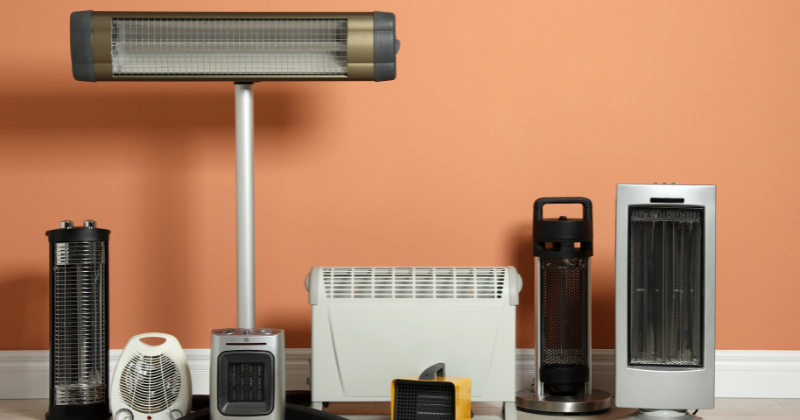
The right size isn’t only about your room; it also depends on the type of heater you’re using, because not all electric heaters warm a space in the same way. Some are made to heat a whole room, while others warm people and objects directly, and that changes how you go about sizing them. Here’s how the main types compare.
- Electric radiators: Designed to warm a whole room evenly, radiators are sized by wattage to suit the size of your space, which is exactly what the 100 watts per square metre rule is all about. These are the focus of this guide.
- Panel and convection heaters: These warm the air in a whole room too, so they’re broadly sized by room size in a similar way, though they tend to be simpler and give you less say over scheduling.
- Infrared and radiant heaters: Rather than warming the air, these send out radiant heat that warms people and objects directly, much like the sun on a bright day. Because of that, you choose them for the area or spot you want to warm rather than by overall room wattage. It’s a similar kind of radiant warmth to the cozy heat our own radiators give off.
- Fan heaters: These blow air across a hot element to take the chill off quickly, so they’re handy for a fast, occasional burst of warmth rather than heating a whole room steadily. You’d choose one for short-term use rather than size it to a room.
For warming a whole room comfortably, with proper control from one room to the next, electric radiators are the choice most people settle on, and they’re what the sizing method in this guide is based on. Within electric radiators, there’s just one more choice to make, and it’s all about how your radiator gives off its heat.
Dry Thermal Radiators
Dry thermal radiators warm up quickly and react fast to any change in room temperature, so your room is comfortable almost as soon as you are, and it’s easy to keep it just right. They’re lightweight and ultra-slim too, which means they slot neatly into just about any room. Our Slimline Curve is a dry thermal radiator, and for most homes it’s the one we’d point you to first, simply because it warms the room faster and responds to temperature changes more quickly than the other types.
Oil-Filled and Ceramic Core Radiators
Oil-filled and ceramic core radiators take a little longer to warm up, but they keep gently giving off heat for a while after the power switches off, much like a traditional central heating radiator. They’re a lovely choice for rooms you like to keep warm over long, steady stretches, though if you want a radiator that’s quick to heat and quick to respond, dry thermal is usually the better all-rounder.
Once you’ve settled on a type, you can also choose how you control your radiator and how it’s fitted, whether that’s wall-mounted, plugged in, or freestanding.
Understanding the Right Electric Heater Size for Your Needs
Selecting the ideal electric heater necessitates a keen understanding of your specific needs. The pivotal query, “What Size Electric Heater Do I Need?”, hinges on several key factors, including the dimensions of your room, the quality of insulation, and your personal comfort preferences.
Whether your search is for an electric heater suitable for a spacious area or a compact one for smaller rooms, familiarizing yourself with the various types on the market is crucial in making an informed decision.
Should you find yourself still uncertain about the optimal choice for your living space, our team is readily available to provide expert, customised guidance. Don’t hesitate to reach out for assistance tailored to your unique requirements.
FAQs
What size electric heater do I need for my room?
Multiply your room’s floor area in square metres by 100 to get a baseline wattage, then adjust upwards for anything that makes the room harder to heat. For an exact figure that takes your room’s features into account automatically, pop your measurements into an electric radiator size calculator.
What size electric radiator do I need for a living room?
Most living rooms are between 12m² and 20m², so a radiator of around 1200W to 2000W will usually do the job. A typical average living room of about 15m² is comfortable with a 1500W radiator, though a larger or open-plan space may be better served by two radiators for even warmth.
What size electric radiator do I need for a bedroom?
A typical double bedroom of around 10m² needs roughly a 1000W radiator, while a smaller single bedroom of 6m² to 8m² is comfortable with 600W to 800W. Bedrooms are often kept slightly cooler than living spaces, so you don’t usually need to size up unless the room is poorly insulated or has a high ceiling.
What size heater do I need for a bathroom?
Bathrooms are small, so they don’t need much output, but they’re usually kept warmer at around 23°C, so allow a little extra. A heated towel rail is a popular choice here, warming the room and your towels at once. Just check it’s rated for wet areas. All of ours are IP65 rated, so they’re good to go.
Do I need one radiator or two?
For most rooms, a single radiator sized to the space is all you need. For larger rooms above around 20m², or long open-plan spaces, two radiators placed in different parts of the room will give more even, consistent warmth than one powerful unit working alone.







Leave a Reply